 Based on 1,000+ Reviews!
Your Furnace Quit on the Coldest Night. Now What?
It’s 6 a.m. The house feels like a refrigerator, and the furnace you’ve ignored for a decade has stopped doing its one job.
Then the second worry hits. What if they can’t even get parts for something this old?
Sound familiar? You’re not alone. If your furnace is 12 years old or older, that fear is the number one thing homeowners tell us. They picture a technician shaking his head and saying, “They don’t make that anymore.” Then comes the $8,000 replacement quote.
Here’s the thing: that’s usually not how it plays out. Most furnace repair on older systems is still very doable. But there are exceptions, and knowing them can save you real money and a lot of stress.
In this guide, you’ll learn which parts are easy to find, which ones can be trouble, and how to decide between a repair and a replacement. We’ll also share how the team at Indoor Comfort Team thinks through that decision for St. Louis homeowners.
Are Parts Really Gone for a 12-Year-Old Furnace?
Short answer: almost never for the common stuff.
A furnace built in 2012 or 2014 is not an antique. Manufacturers are expected to support their equipment for years, and the aftermarket fills in a lot of the gaps. Parts that fail most often are the same ones across thousands of models. That means suppliers keep them on the shelf.
The parts that wear out first are small and cheap compared to the whole furnace. Think igniters, flame sensors, pressure switches, capacitors and blower motors. These are routine furnace repair jobs, and a good technician replaces them all the time.
But here’s what matters. “Available” and “worth it” are two different questions. A part can be easy to find and still be a poor investment if the furnace around it is on its last legs. We’ll get to that.
Where Older Furnaces Run Into Real Trouble
Now for the honest exceptions. This doesn’t work out well if your furnace is truly old, say 20 years or more, or if it’s from a brand that has since folded.
Control boards are the usual headache. Many are built for one specific model. When a manufacturer retires that board, a replacement can be hard to track down. Sometimes a universal or cross-reference board works. Sometimes it doesn’t.
Gas valves and inducer assemblies can also be tricky on discontinued models. And if your furnace still has a standing pilot light, you’re in older-equipment territory where parts may be limited.
So what should you do? Don’t guess, and don’t take a stranger’s word for it over the phone. Have a technician look at the model and serial number, then check real supplier availability. That one step turns a scary unknown into a clear answer.
What Furnace Parts Cost and How Easy They Are to Find
Let’s put some order to this. The table below gives general ranges for common repairs on furnaces roughly 12 to 20 years old. Actual prices vary by model, brand and labor, so treat these as a starting point, not a quote.
Common Part | What It Does | Typical Availability | Rough Repair Cost Range (parts and labor) |
Igniter | Lights the burner | Easy to find | $150 to $400 |
Flame sensor | Confirms the burner is lit | Easy to find | $100 to $300 |
Capacitor | Helps motors start | Easy to find | $150 to $400 |
Pressure switch | Safety check on venting | Usually easy | $175 to $450 |
Blower motor | Moves warm air through the house | Often available, varies by model | $450 to $1,500 |
Inducer motor | Pulls exhaust out of the furnace | Varies by model | $400 to $1,200 |
Control board | The furnace’s brain | Can be hard on older or discontinued models | $350 to $900+ |
Heat exchanger | Transfers heat to your air | Rarely worth replacing on an older unit | Often near the cost of a new furnace |
Notice the pattern. The cheap, frequent repairs are the easy ones to source. The expensive ones, especially the heat exchanger, are where you start asking bigger questions.
The Question Nobody Wants to Ask: Repair or Replace?
 You might feel stuck right about now. If you repair it, are you throwing money at a dying machine? If you replace it, are you getting upsold?
It’s frustrating, because the person diagnosing your furnace is often the same person paid to sell you a new one. That’s the part that makes homeowners nervous, and honestly, it should make you a little skeptical.
A Simple Rule of Thumb That Actually Works
Many heating pros use a quick check. Multiply the age of your furnace by the repair cost. If the number lands above roughly $5,000, replacement starts to make more sense.
Example: a 15-year-old furnace with a $400 repair gives you $6,000. That’s a flag. The same furnace with a $200 repair gives you $3,000, so repairing probably wins.
It’s a guide, not a law. Use it to start the conversation, not end it.
When Repair Is the Smart Move
Repair usually wins when the furnace is under about 15 years old, the problem is one common part, and the system has been heating your home evenly. A $300 fix that buys you three more good winters is a great deal. Nobody should push a $12,000 system on you for that.
At Indoor Comfort Team, our owner, Adam Rahmanovich, trained as an engineer. That shapes how our team works. We’d rather diagnose the problem correctly and tell you “repair it” than sell you something you don’t need. You can read more about that approach on our Meet the Owner page.
When Replacement Starts to Make Sense
Sometimes the math just flips. Here are the situations where we’d have an honest talk about replacing.
A cracked heat exchanger is the big one. It’s a safety issue because it can let carbon monoxide into your home, and the repair often costs close to a new furnace. Add in a furnace older than 18 to 20 years, repeated breakdowns in a single season, or a control board that’s no longer made, and a new system becomes the more sensible choice, and you can get a price range online in minutes.
Rising gas bills matter too. A furnace from the early 2000s may run at around 80% efficiency, while newer models can reach 95% or more. That gap shows up every month in winter.
If you land here, you can explore heating installation options and check financing before deciding anything. Ask about current terms, since offers change.
Signs Your Furnace Is Asking for Help
Furnaces rarely die without warning. They whisper first, then shout.
Listen for banging, squealing or rattling. Watch for a furnace that turns on and off every few minutes, which techs call short cycling. Notice rooms that never get warm, or a pilot or burner flame that looks yellow instead of steady blue. A yellow flame is a safety concern, so don’t wait on that one.
The good news? Catching these early often keeps the fix small. A $150 flame sensor today beats a no-heat emergency in January.
What a Good Furnace Repair Visit Should Look Like
Not every service call is created equal. Here’s what you should expect.
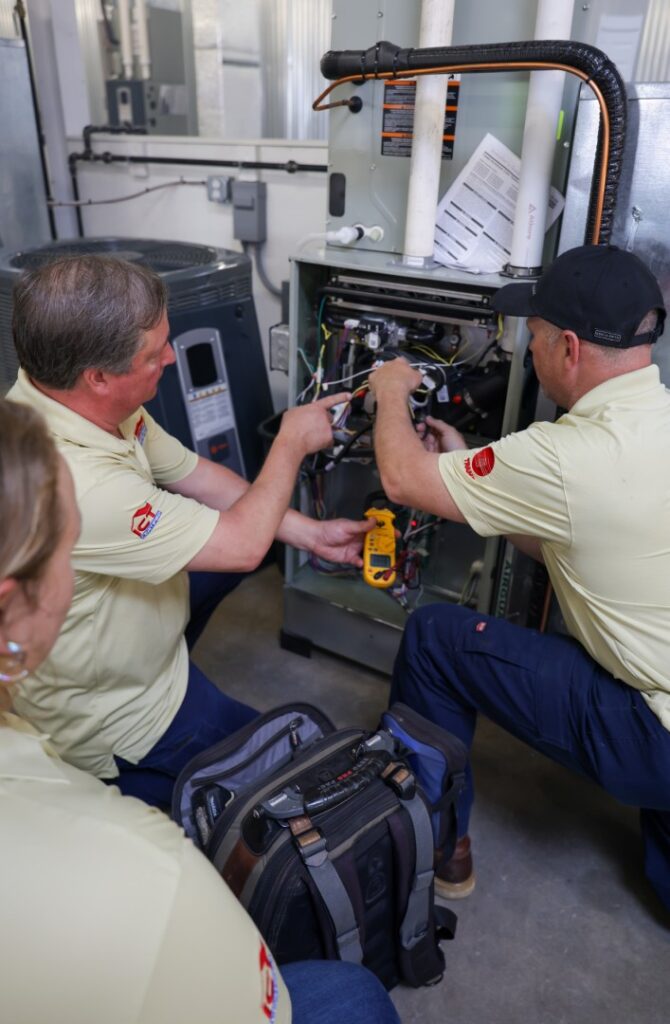
A solid technician starts by listening to you. What happened? When? Any strange sounds or smells? Then they inspect the furnace, test the safety controls and check the airflow. They should explain what failed, why it failed and what it costs before any work begins.
Upfront pricing is the key piece. You should know the number before the wrench turns. No surprises, no pressure.
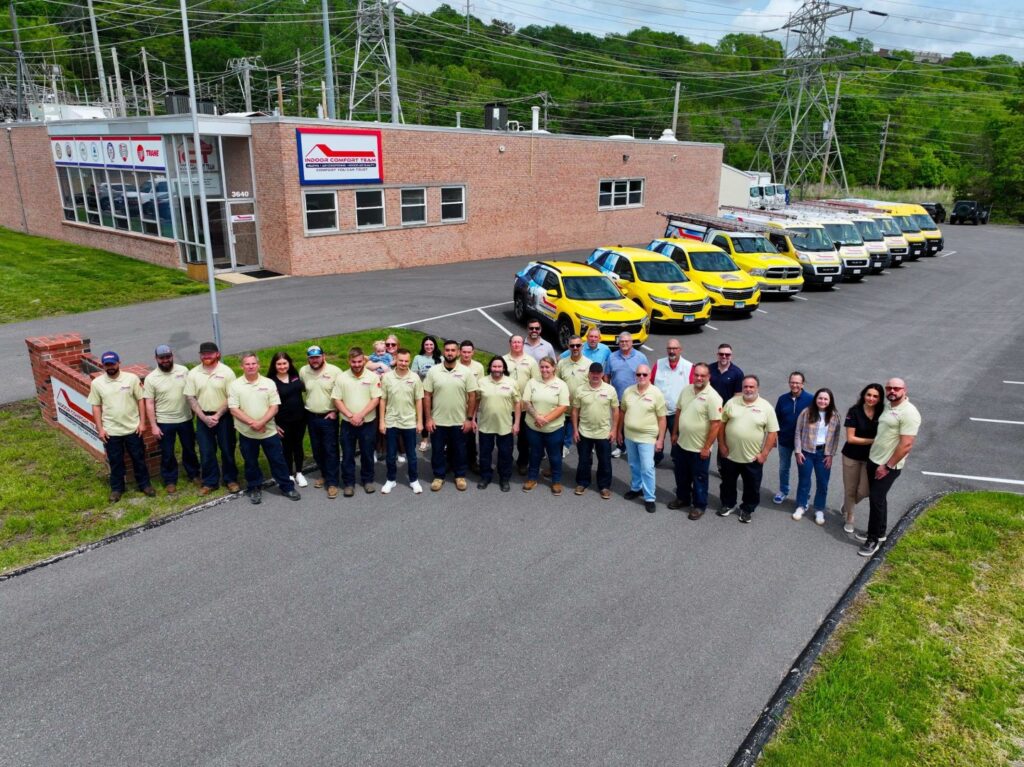
Training matters too. Our technicians are background-checked and NATE-certified, and we train them through our own ICT Certification Program. We don’t use subcontractors. The person who shows up works for us, and many of our techs have been with the company for years, so they get to know the homes they service.
And if the furnace is old, a good tech will check parts availability on the spot rather than leaving you to wonder.
Why Old Furnaces Fail More in Cold Snaps
Here’s something most articles skip. Furnaces don’t break at random. They break when they work hardest.
On a mild fall day, your furnace runs short cycles and coasts. During a St. Louis cold snap with single-digit temperatures, it runs for hours. Every weak part gets tested at once. A tired igniter, a dirty flame sensor, a worn blower motor: they all pick the worst night to quit.
That’s also when parts and technicians get stretched thin. Everyone’s furnace is breaking at the same time. If you’ve been putting off a tune-up, this is why fall matters.
An annual check lets a technician catch weak parts before the cold hits. It also gives you time to order a hard-to-find part instead of scrambling in an emergency. Our VIP Club Plan is built around that idea: same team, your system history on file, and priority scheduling.
Frequently Asked Questions
Can you still get parts for a furnace that’s 12 to 15 years old?
In most cases, yes. Common parts like igniters, flame sensors, capacitors and motors are widely available for furnaces in this age range. The main exceptions are model-specific control boards and some inducer assemblies. A technician can check your model number and confirm availability before you commit to a repair.
How long does a furnace usually last?
Most gas furnaces last about 15 to 20 years when they’re well maintained. Climate, usage, filter habits and installation quality all play a part. A furnace that gets a yearly tune-up often outlasts one that’s ignored.
Is it worth repairing a 15-year-old furnace?
Often, yes, if the repair is minor and the system is otherwise healthy. A quick test is to multiply the furnace’s age by the repair cost. If the result is well under $5,000, repair is usually reasonable. If the problem is a cracked heat exchanger or a repeat failure, replacement usually makes more sense.
What if my furnace breaks after hours?
Heating problems don’t keep business hours. Indoor Comfort Team offers after-hours emergency service at the same upfront pricing you’d get during the day. Call us at (314) 230-9542, or (618) 688-0707 for urgent repairs on the Illinois side.
Don’t Wait for the Cold to Find Out
Let’s pull it together. Parts for furnaces 12 years and older are usually available, especially for the common repairs. Control boards and inducer parts on older or discontinued models are the main exceptions. And repair versus replace is a math problem, not a sales pitch: look at age, repair cost, safety and efficiency together.
Most of all, you deserve a straight answer. You shouldn’t have to wonder whether the person in your basement is working for you or for a sales quota.
Indoor Comfort Team has served St. Louis and the Metro East since 1979, and our approach hasn’t changed: get it right before we sell you anything. If your furnace is acting up, or you just want to know how much life it has left, request service or learn more about our heating repair services. If you’d like to see how our neighbors feel about us, read our reviews and testimonials.
Your furnace doesn’t have to be a mystery. Call (314) 230-9542 and get an honest assessment before the next cold snap, not during it.