
 Based on 1,000+ Reviews!
Your AC Is Running — So Why Is Your House Still Hot?
It’s 95 degrees outside. Your air conditioner has been humming for two hours straight. But you’re still sweating on your own couch.
Sound familiar?
You’re not alone. This is one of the most common — and most frustrating — comfort problems homeowners in the St. Louis area face every summer. The good news? There’s usually a clear reason it’s happening. And most of the time, it’s fixable.
Here’s what you need to know.
The Real Reasons Your Air Conditioning Struggles
Your System Might Be the Wrong Size
Look, this surprises a lot of people. Bigger isn’t always better with air conditioning.
An oversized AC unit cools your home so fast that it shuts off before it can remove humidity. You end up with a house that feels cold but clammy — like walking into a wet towel. An undersized unit, on the other hand, just never catches up on a hot day.
Here’s the thing: proper sizing requires a load calculation based on your home’s square footage, insulation, window placement, and even which direction your house faces. A lot of contractors skip this step. The ones who don’t — that’s who you want.
Refrigerant Is Low (And That’s Not Normal)
Your air conditioner doesn’t “use up” refrigerant the way a car uses gas. If it’s low, that means there’s a leak somewhere.
Low refrigerant means your system has to work harder to do the same job. You’ll notice longer run times, rooms that never quite reach the thermostat setting, and sometimes ice forming on the outdoor unit. Ignoring it leads to compressor damage — and compressor replacement is expensive.
This is not a DIY repair. Refrigerant handling requires certification, and the fix needs to start with finding and sealing the leak.
Dirty Coils and Clogged Filters Are Quietly Killing Efficiency
Your air conditioner pulls warm air across a cold coil to cool it. When that coil gets dirty — or when the filter upstream is clogged — airflow drops. Less airflow means less cooling, even if the system is technically “working.”
It’s frustrating when you’ve replaced the filter once or twice and still feel like something’s off. That’s because the evaporator coil itself needs professional cleaning on a regular maintenance schedule.
A clean system can run 10–15% more efficiently than a neglected one. That shows up on your energy bill.
The System Is Just Old
Air conditioners don’t last forever. Most residential systems have a useful life of 15–20 years with proper maintenance. After that, efficiency drops, parts wear out, and repairs start adding up fast.
If your system is pushing 15 years old and you’re calling for repairs every summer, you might be spending good money to keep a struggling machine alive. A newer, properly sized system with a high SEER2 rating could actually pay for itself in lower utility bills over time.
How Much Should Air Conditioning Actually Cost to Run?
One of the most common questions homeowners ask is whether their energy bills are normal. Here’s a general comparison of what affects your monthly cooling costs:
| Factor | Lower Cost | Higher Cost |
| System age | Less than 10 years old | 15+ years old |
| SEER2 rating | 16+ (high efficiency) | 10 or below (older standard) |
| Filter condition | Clean, replaced regularly | Clogged or neglected |
| Thermostat type | Smart/programmable | Manual, set to constant temp |
| Home insulation | Well-sealed, modern insulation | Drafty, older construction |
| Maintenance history | Annual tune-ups | No recent service |
A well-maintained, properly sized system in an average St. Louis home will almost always outperform an older neglected one — even if the older one cost more when it was installed.

Noisy AC? That’s Your System Trying to Tell You Something
You might feel overwhelmed trying to figure out what all the sounds mean. Here’s a quick translation.
A banging or clanking noise usually means something is loose inside the unit — a fan blade, a mounting bracket, or a component that’s come free. Shut it off and call for service.
A hissing or bubbling sound often points to a refrigerant leak. Don’t ignore this one.
A clicking that won’t stop after startup can mean an electrical issue — a failing relay or capacitor.
A high-pitched squealing usually means a worn belt (on older systems) or a failing motor bearing.
Here’s what matters: none of these sounds are “just how it is.” Your air conditioner should run relatively quietly. When it starts making new noises, that’s a signal — not background noise to get used to.
What a Proper AC Tune-Up Actually Includes
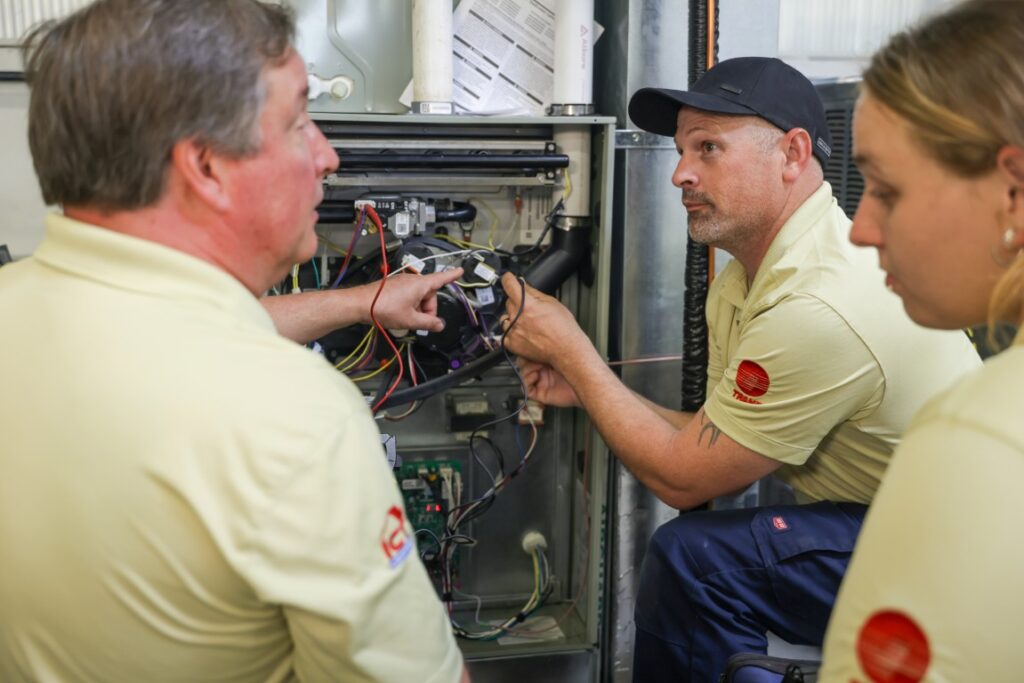
A real tune-up isn’t just someone showing up and glancing at your outdoor unit. When Indoor Comfort Team’s NATE-certified technicians perform a maintenance visit, they’re checking dozens of components — including refrigerant levels, electrical connections, coil condition, thermostat calibration, and airflow measurement.
The difference between a real tune-up and a drive-by inspection is the difference between finding a small issue early and getting hit with an emergency repair bill in July.
Our technicians are background-checked and NATE-certified. That’s not just a credential on a wall — it means they passed a nationally standardized test on HVAC systems. They know what they’re looking for.
Want to learn more about our air conditioning maintenance and tune-up services or explore what a new AC installation looks like? We’ve been doing this in St. Louis since 1979.
When to Repair — and When to Replace
This is the question everyone dreads, because nobody wants to hear “replace it.”
But here’s an honest framework. Multiply your repair estimate by the age of your system. If that number exceeds $5,000 — or more than half the cost of a new system — replacement usually makes more financial sense.
The exception is if your system is under 10 years old and well-maintained. In that case, a targeted repair often makes sense.
If your system is 15 years old and you’ve already spent on it in the last two years, you’re probably throwing good money after bad. A transparent conversation with a technician you trust will tell you more than any online calculator.
We never push replacement when repair is the right answer. Our money-back guarantee and 100% satisfaction promise exist because we want you to feel confident in whatever direction we recommend — not pressured.
You can also explore financing options for new systems if upfront cost is a concern. We offer 0% financing on qualifying installations.
Frequently Asked Questions
How often should I have my air conditioner serviced? Once a year, ideally in the spring before cooling season starts. Annual maintenance keeps your system running efficiently, catches small issues before they become big ones, and is often required to keep manufacturer warranties valid. Most homeowners who skip it end up spending more in repairs over time than the cost of consistent tune-ups.
Why does my air conditioner keep turning on and off every few minutes? That’s called short-cycling, and it’s a problem. It usually means the system is oversized for your home, there’s a refrigerant issue, or the thermostat is malfunctioning. Short-cycling causes extra wear on the compressor — the most expensive part of your system. Get it diagnosed sooner rather than later.
What SEER2 rating should I look for in a new AC unit? In Missouri and Illinois, the minimum efficiency standard for new systems is 14.3 SEER2. For most homeowners, a 16–18 SEER2 system hits the sweet spot of efficiency and cost. Higher ratings (20+) make sense if you have very high cooling loads or plan to stay in your home long-term. A proper load calculation will help match the right system to your home.
Can I just add refrigerant myself to fix my AC? No — and legally, you can’t purchase the refrigerant without EPA certification anyway. More importantly, adding refrigerant without finding the leak first just delays the real fix. Once the leak worsens, you risk damaging the compressor. The right move is a proper leak search and repair, followed by a recharge to the correct level.
Don’t Sweat It — The Right Help Is a Phone Call Away
Here’s the bottom line: a struggling air conditioner usually has a fixable cause. It’s not something you have to just live with.
Whether it’s a clogged filter, a refrigerant leak, a system that’s past its prime, or a noise that’s been bugging you for months — there’s a diagnosis behind it and usually a clear solution.
Indoor Comfort Team has been solving exactly these problems for St. Louis homeowners since 1979. Over 4,900 verified reviews at 4.9 stars. NATE-certified technicians. A triple guarantee covering workmanship, satisfaction, and your money back if you’re not happy.
We’re not the kind of company that shows up with a sales pitch. We show up with answers.
If your air conditioning isn’t doing its job, contact Indoor Comfort Team today and let’s figure out what’s going on — before the next heat wave hits.
Indoor Comfort Team serves the greater St. Louis area across both Missouri and Illinois. Licensed, insured, and independently family-owned since 1979.